
Promotion and Tenure Policy Changes
During the 2021-2022 Academic Year, Faculty Policies related to performance evaluation (FP103) and promotion or tenure (FP104) were recommended for revision to address a number of issues related to clarity and equity within the processes. This process has continued into the 2022-2023 Academic Year. This page will specifically address the policy changes to FP104 regarding promotion and tenure.
Challenges to be Solved
Not all faculty at the University have a clear path to promotion to the Professor rank.
- FP104 neglects to articulate a comprehensive and equitable rank system that recognizes and provides opportunities for rank advancement to all faculty.
- As a growing University, FP104 requires flexibility to recognize the talents and skills of all its full-time faculty and their unique contributions to the University and its students.
- Current FP104 doesn’t provide a path to promotion for faculty currently in the instructor rank.
- Criteria for promotion in current FP104 is unclear and doesn’t relate to faculty performance evaluation criteria.
- Faculty track and rank are not fully aligned to the work expectations.
Faculty who are terminally credentialed are not acknowledged for their additional expertise
- An appropriately credentialed professoriate is a commonly understood convention and practice among accreditors.
- Faculty rank promotion is a system designed to reward and distinguish faculty for individual achievement such as credential attainment.
Time to promotion is unclear.
- FP104 has unclear language about time in rank expectations resulting in confusion for faculty.
- University practice lacks mechanism(s) to prepare and communicate to faculty their readiness for promotion.
Recognition for promotion doesn’t incentivize participation.
- Faculty have expressed that the amount of effort to prepare a dossier for promotion isn’t worth the salary increase.
- Faculty have expressed that the higher ranks don’t carry benefits that reward faculty for achieving those ranks.
Letter of Appointment (LOA) and multi-year appointment processes lack meaning for non-tenure faculty.
- The University’s annual LOA process might be eroding morale since it symbolically and literally reminds faculty of their at-will nature on a yearly basis.
- The multi-year appointment model doesn’t achieve the University’s goal: to demonstrate a shared commitment of employment between the faculty member and the University.
Proposed FP104 Changes
IPTRC and a sub-committee of IPTRC has been working with the Provost Office and Academic Cabinet to address the Challenges to be Solved. The group has revised the policy. Here is the Proposed Expanded Appointment & Rank System PPT - which was presented to Faculty Senate on March 19, 2023.
Also, here is a link to the new FP104: Section 104 - Awarding Promotion, Tenure, and Multi-year Appointments.
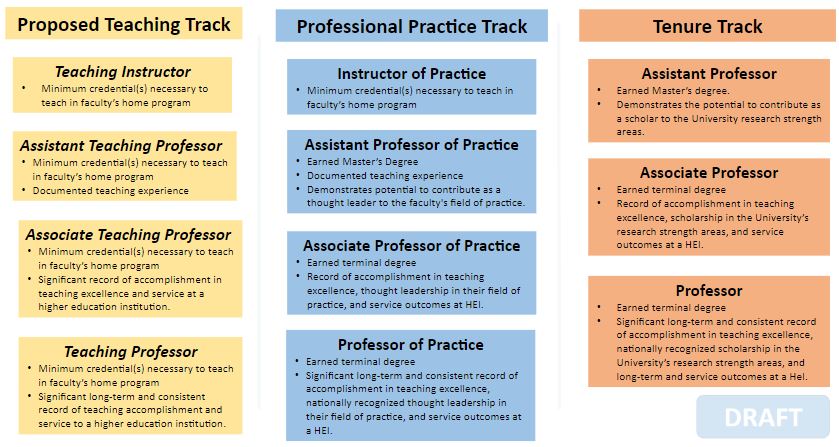
Frequently Asked Questions (FAQ)
Below you will find a series of questions that have arisen regularly throughout the process. Please review to see if your questions may have already been answered. If you do not see your question addressed, please use the anonymous survey to the right to ask your question. The Provost's Office and working group will make every effort to answer your question in a timely manner and add it here, if appropriate.
A: IPTRC, Provost Office, and Academic Cabinet will collaborate on an Implementation Plan that will be released by July 1, 2023 and will be executed through June 30, 2024. Below are some high-level thinking about that plan so far.
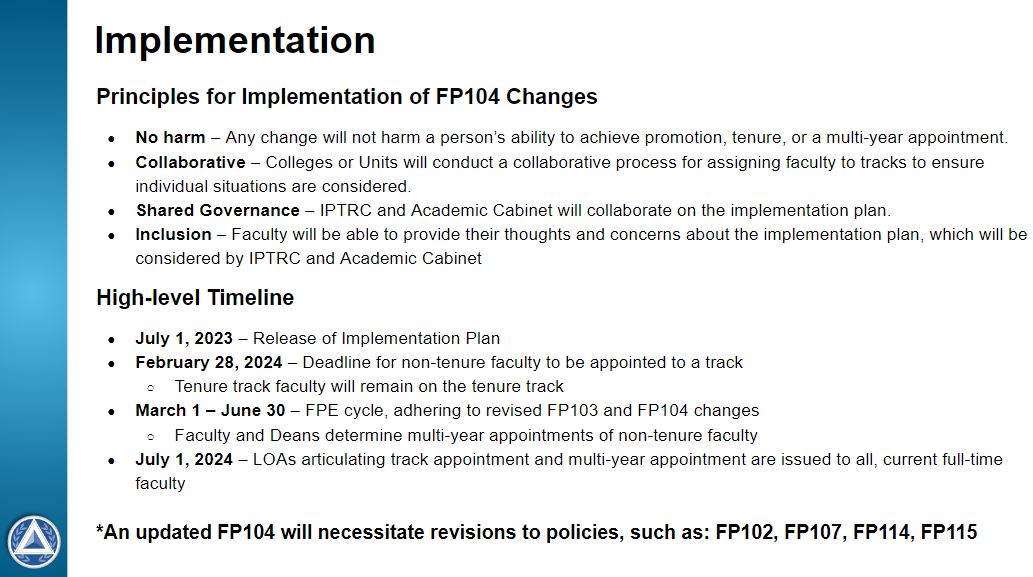
A: The IPTRC working group will write policy language to guide track changes. Although track changing might be recommended for some faculty during their career at the University, track changing will not be a frequent occurrence and tracking changing will not happen multiple times for a single faculty member.
A: Tenure track positions will always be publicly posted and use an application process. Faculty will not be able to “move” to the tenure track via a re-appointment by the Dean, Provost, or President.
A: Not necessarily. The teaching track is designed for faculty whose primary contribution to the University, college, and program is teaching excellence.
A: Merit raises are determined by the University’s financial standing and using various performance factors, the discretion of the faculty’s supervisor and Dean. A faculty member’s track appointment doesn’t impact one’s merit raise. All faculty member, regardless of track, are eligible for merit raises.
A: Yes, all faculty will be eligible. FP107 guides the University’s Sabbatical awards and will need to be updated to include the Teaching track after approval of FP104.
A: Tenure track positions will always be determined before posting the position and will use an application process for hiring. When hiring non-tenure track - professional practice and teaching track faculty - the University will post these positions as open ranked and open track and the track and rank will be determined based on the University, college, and program needs and candidates qualifications and experience.
A: The broader Higher Education Institution (HEI) language is used to allow the flexibility to appoint a newly hired faculty member the associate professor or professor rank, if that person has had previous experience at another HEI warranting either of these titles. This rarely happens, but we want to maintain the flexibility in case the situation presents itself.
A: Yes. Rank advancement salary raises will be the same for each track.
A: It is a higher education convention to differentiate the faculty track appointments with rank titles. Many Chicagoland Universities follow this convention. For example, Roosevelt University uses different titles for their teaching track, clinical faculty track, and professional practice track - see the chart on page 34 of their Faculty Handbook. Additionally, you can read the research study, Are “associate professors” better than “associate teaching professors”? Student and faculty perceptions of faculty titles. The IPTRC working group carefully considered this change before making the recommendation to align the rank titles with the tracks.
A: Tenure track opportunities are determined by the Dean, Provost, and President.
A: Since Teaching track faculty mainly contribute to the University, College, and Program by teaching courses, the minimum credentials for rank promotion are aligned with the program’s faculty credentialing requirements for the program which the faculty member resides. Further, the Teaching track provides an opportunity for equitable recognition and advancement for faculty teaching in programs and disciplines where a terminal degree isn’t required.
A: Years in rank toward rank promotion is negotiated at the time of hire. There is language in the revised FP104 guiding this process. Kendall College faculty who came to NLU as part of the acquisition have their time in rank at Kendall College recognized; however, faculty hired from Argosy upon Argosy’s closure do not have their years in rank at Argosy recognized, since Argosy was not an acquisition.
A: Tenure track faculty will be expected to be principal investigators (PI) and submit grant proposals to support their thought leadership in the University’s strength areas. Professional practice track faculty are expected to make thought leadership contributions, and although they are encouraged and will be supported by the University to submit grant proposals and support other faculty and staff with grant projects, they aren’t expected to serve as PIs on grant proposals or to seek funding to support their thought leadership.
A: The revised policy features a specific, minimum number of years in rank to determine eligibility for promotion to the next rank. It is clearer to faculty to communicate a specific number of years to avoid confusion.
Faculty Policy 104 Implementation Plan
To learn more about how these policy changes will be rolled out, please visit the FP104 Implementation Plan page.
Promotion and Tenure Support
For resources to support you on your Promotion and Tenure journey, please use the button below to view guides, templates, and timelines for the Promotion and Tenure process.

Submit Your Feedback
Please use the survey below to anonymously share your questions or comments regarding the changes to Faculty Policy 104. The survey also provides a space to share thoughts on implementation.