Subject Matter Guide
Faculty develop the ability to help students, who are mostly novices, acquire the knowledge, skills, and disposition to acclimate to the discipline’s professional practice.
- Faculty guide students into their deep, evolving, and foundational knowledge in their content area.
- Faculty model to students the way a practitioner solves problems and applies the discipline’s skills and knowledge in a professional setting. (Jump to section)
- Faculty apply discipline-specific learning research to their teaching practice. (Jump to Section)
- Faculty use industry examples, case studies, simulations, professional interactions, and community experiences to help students connect their learning to real-world contexts, encouraging them to apply knowledge in ways that prepare them for meaningful professional and societal contributions. (Jump to Section)
1) Faculty guide students into their deep, evolving, and foundational knowledge in their content area.
Below are some examples of the ways that faculty guide students into their deep foundational knowledge.
Connecting Knowledge to Content
We need to understand the cultures, histories, and knowledge that students are bringing to the classroom. This will help us guide students to connect the course content to the wealth of knowledge they bring with them. Ask students to share the kinds of stories and lessons shared among their families and communities. Also, consider creating a Background Knowledge Probe (from the K. Patricia Cross Academy).
Retrieved from the K. Patricia Cross Academy (https://kpcrossacademy.org/videos/)
Intellectual Development
To better guide students into their deep understanding of the content, it will help to know the stages of intellectual development so that you can identify where students are at in their field-specific knowledge acquisition. Please review the following information on the intellectual development of college students based on William Perry's theory of intellectual and ethical development:
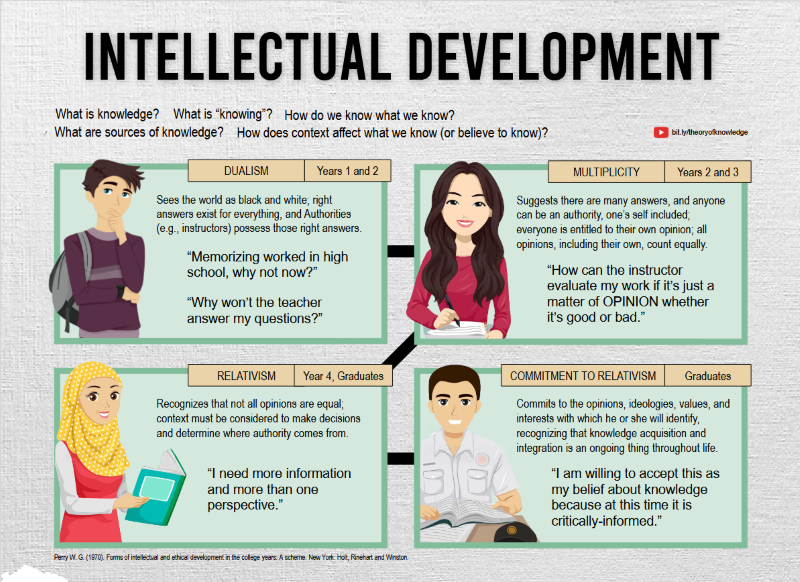
Download a copy of the Intellectual Development PDF
Faculty Dispositions
Student Dispositions - What dispositions do your students need?
While there are many dispositions you will see in your classroom, there are a few that occur more frequently than others. Review the list below of common challenges your students may experience and which disposition will guide them to success. Before reviewing this table, we must first examine whether we have created a safe environment for students. For example, have we done everything in our power to reduce stereotype threat? Have we vocalized our biases and engaged student to create ground rules for group conversations? Only after we are sure that we have checked our biases and created a safe space for students, can we have a conversation with students about their dispositions.
For more regarding mitigating bias, please visit the Community Builder domain of the Teaching Excellence Framework. It is also recommended that you visit our continuously evolving Culturally Responsive Pedagogy page to learn more and contribute to the conversation.
| We Observe Our Students | Disposition They Might Need |
| Giving up easily without trying | Perseverance |
| Blurting out answers or starting a task without knowing what to do | Managing their impulsivity |
| Lacking curiosity | Questioning |
| Responding with apathy, (“Who cares”) (“It’s boring”) | Finding wonderment and awe |
| Being disrespectful of others | Listening with understanding and empathy |
| Unable to apply what they have learned | Drawing on prior knowledge and applying it to new situations |
| Afraid to try (Faculty: Have you done enough to create a safe space?) | Being adventuresome, Risk-taking |
| Believing that they lack creativity | Creating imagining and innovating |
| Using vague, imprecise language, "there are things that could be better" | Using clear and precise language, ask "what things? and "better how?" |
| Unaware of their own thought processes | Metacognition: Thinking about their thinking |
2) Faculty model to students the way a practitioner solves problems and applies the discipline’s skills and knowledge in a professional setting.
Below are ways that subject matter guides model to students how practitioners solve problems.
Modeling Approaches from the Field
Sometimes, we are concerned that students must acquire knowledge or skill in the content area before they can engage in inquiry, address a complex problem, or tackle a real-world project. We can challenge them to instead think of the problem, project, or scenario as anchoring the learning experience. When students create the scenarios, they can bring their own lived experiences into the classroom and create meaningful connections between previous knowledge and new information. Keep in mind that student-centered emphasizes sustained inquiry, student voice and choice, authenticity (as perceived by the students), and reflection.
Check out the Case Studies drop-down to explore further. You may also be interested in reviewing the High Impact Teaching Strategy (HITS): Worked Examples.
Case studies are a great way to engage students using narrative and problem-solving, and encourage students to bridge their existing knowledge to course content.
From: The K. Patricia Cross Academy (https://kpcrossacademy.org/videos/)
3) Faculty utilize discipline-specific research and tools in their teaching practice.
Discipline-specific Research
What is meant by discipline-specific research? These are the tools, research, and reference points common for your profession. For example, Clinical Psychologists use the Diagnostic and Statistical Manual of Mental Disorders 5-TR for guidelines to diagnose patients, researchers in your field operate under an Institutional Review Board, Nurses use clinical practice guidelines to optimize patient care, and teachers may use High Impact Teaching Strategies to guide their classroom practice. All of these are examples of research-based tools that guide professionals in their respective fields.
Think of the industry-specific tools, databases, and research journals that students entering the field will be utilizing. Are there credentials available for those tools that you could encourage students to pursue? Are there conferences that students should consider attending. For example, for Industrial Organizational Psychologists, the Society for Industrial Organizational Psychology (SIOP) Conference is one that professionals in this field really should strive to attend every year.
4) Faculty use industry examples, case studies, simulations, professional interactions, and community experiences to help students connect their learning to real-world contexts, encouraging them to apply knowledge in ways that prepare them for meaningful professional and societal contributions.
Below are some examples of the ways that faculty use industry-specific examples, case studies, and other tools faculty use to connect class material to real-world contexts.
Connecting Learning to Real-world Context
Faculty intentionally design and facilitate learning experiences that connect course concepts to authentic professional and societal contexts. They use industry examples, case studies, simulations, professional interactions, and community experiences so students can apply knowledge and skills to real-world problems. In doing so, they help students see the relevance of their learning, develop professional identity, and prepare for meaningful contributions in their careers and communities.
Faculty who excel at bringing real-world context to the classroom deliberately design learning experiences that mirror the realities students will encounter in their professions and communities. Rather than relying solely on abstract explanations or textbook examples, they bring in current industry cases, community issues, and authentic scenarios that show how course concepts actually operate in the world. They frame activities as “what professionals in this field do,” helping students see themselves as emerging practitioners and leaders. In this way, students begin to form a sense of professional identity while also understanding the broader societal implications of their work.
Also, faculty can focus on authentic application and the transfer of learning. They can choose examples, case studies, simulations, and projects that are complex, sometimes messy, and grounded in real stakeholder needs. They make the connections between theory and practice explicit—guiding students to use course concepts to analyze problems, make decisions, and propose solutions, and then reflecting back on how those experiences deepen their understanding of the underlying ideas. Over time, they intentionally increase the complexity and openness of tasks, moving students from guided practice toward more independent, real-world problem-solving.
Connecting this to our Community Builder domain, we must also be attentive to relevance, equity, and impact. When we draw from real-world contexts, they should be from diverse communities, cultures, and sectors, so students grapple with ethical considerations, power dynamics, and questions of inclusion as part of their disciplinary work. Faculty build partnerships with professionals and community organizations, inviting guest speakers, organizing site visits, or coordinating collaborative projects that give students direct insight into professional expectations and community needs. Throughout these experiences, students are encouraged to reflect on who is affected by their decisions, how their skills can contribute to more just and effective practices, and what it means to use their learning in ways that matter beyond the classroom.
- Industry Case Analysis - In a business or management course, the instructor uses a recent case from a relevant industry (e.g., hospitality, tech, healthcare) and asks students to:
- Analyze the problem from multiple stakeholder perspectives.
- Apply course frameworks (e.g., service leadership, organizational behavior).
- Recommend an action plan with consideration for ethics, equity, and long-term impact.
- Simulated Professional Scenario - In an education or counseling course, students engage in role-play and real-play simulations:
- Practicing parent–teacher conferences, intake interviews, or IEP meetings.
- Receiving structured feedback using a rubric aligned with professional standards.
- Debriefing the simulation to link their choices back to course concepts.
- Community-Engaged Project - In a social sciences or public health course, students partner with a local community organization to:
- Identify a real need or question (e.g., awareness campaign, basic data collection, outreach materials).
- Use course theories and methods to design a small, feasible project.
- Present findings or products to the community partner and reflect on lessons learned.
- Professional Artifact Creation - In a teacher leadership or leadership studies course, students create artifacts professionals actually use. Note: These are assessed both for content accuracy and real-world usability.
- A professional development session plan.
- A policy brief for school or organizational leaders.
- A short training module or resource guide for colleagues.
- Guest Expert + Application Task - After a guest speaker from industry, a nonprofit, or a public agency:
- Students complete a brief analysis of the speaker’s context using course frameworks.
- They design a follow-up recommendation, product, or strategy that could realistically be used in that setting.
- Data-Driven Decision-Making Task - In a research methods or analytics course, students work with a de-identified dataset from an organization:
- Pose authentic questions related to practice (e.g., student outcomes, customer satisfaction, community needs).
- Conduct appropriate analyses.
- Present findings as if to a decision-making audience, focusing on clarity, limitations, and ethical considerations.
- Scenario-Based Assessments - Instead of (or alongside) traditional exams, assessments are built around realistic scenarios:
- Students read a short scenario, identify the core issue, choose and justify a course of action, and predict possible outcomes.
- Rubrics assess accurate application of knowledge, reasoning, and attention to equity/ethics.
- Multi-Modal Simulations - In health, science, or technical programs:
- Students use simulations, labs, or virtual environments to practice skills (e.g., responding to a crisis, running an experiment, troubleshooting a system).
- Faculty explicitly connect each step in the simulation to real protocols, standards, or common workplace challenges.
- Community Storytelling and Reflection - In humanities or social sciences, students:
- Collect stories through interviews, oral histories, or media from diverse community members.
- Analyze these stories using course lenses (e.g., critical theory, culturally responsive frameworks).
- Reflect on how their learning shapes their responsibilities as professionals and citizens.
- Capstone or Signature Project - A culminating experience asks students to:
- Identify a real-world problem relevant to their field.
- Apply course/program knowledge to propose or implement a solution or improvement.
- Share their work with an authentic audience (e.g., community partners, advisory boards, campus stakeholders).
Recommended Reading
Altan, S. & Lane, J.F. (2018) Teachers' Narratives: A source for exploring the influences of teachers' significant life experiences on their dispositions and teaching practices. Teaching and Teacher Education. 74, 238-248. http://repository.bilkent.edu.tr/bitstream/handle/11693/49957/Teachers_narratives_A_source_for_exploring_the_influences_of_teachers.pdf?sequence=1
Bradley, E., Isaac, P., & King, J. (2020). Assessment of Pre-Service Teacher Dispositions. Excelsior: Leadership in Teaching and Learning, 13(1). https://doi.org/10.14305/jn.19440413.2020.13.1.03
Costa, A. L., & Kallick, B. (2013). Dispositions: Reframing teaching and learning. Corwin Press. https://i-share-nlu.primo.exlibrisgroup.com/permalink/01CARLI_NLU/17rjffu/alma995176412905908
Ginsberg, M. B. (2015). Shadowing a student shows how to make learning more relevant. Phi Delta Kappan, 97(4), 26-30.
Kaslow, N. J., Grus, C. L., Campbell, L. F., Fouad, N. A., Hatcher, R. L., & Rodolfa, E. R. (2009). Competency Assessment Toolkit for professional psychology. Training and Education in Professional Psychology, 3(4S), S27.
Woodruffe, C. (1993). What is meant by a competency? Leadership & organization development journal.
Yao, Y., Pagnani, A., Thomas, M., Abellan-Panani, L., Brown, T., Buchanana, D.L. (2017). Measuring teacher dispositions: Identifying workplace personality traits most relevant to teaching professions. Mid-Western Educational Researcher. 29(4), 308-331. https://www.mwera.org/MWER/volumes/v29/issue4/V29n4-Yao-FEATURE-ARTICLE.pdf